CISA will Showcase Top Cyber Leadership, Operational Collaboration and Innovation at Annual Government-Industry Summit.
Category: Uncategorized
-
GOP Cries Censorship Over Spam Filters That Work
The chairman of the Federal Trade Commission (FTC) last week sent a letter to Google’s CEO demanding to know why Gmail was blocking messages from Republican senders while allegedly failing to block similar missives supporting Democrats. The letter followed media reports accusing Gmail of disproportionately flagging messages from the GOP fundraising platform WinRed and sending them to the spam folder. But according to experts who track daily spam volumes worldwide, WinRed’s messages are getting blocked more because its methods of blasting email are increasingly way more spammy than that of ActBlue, the fundraising platform for Democrats.
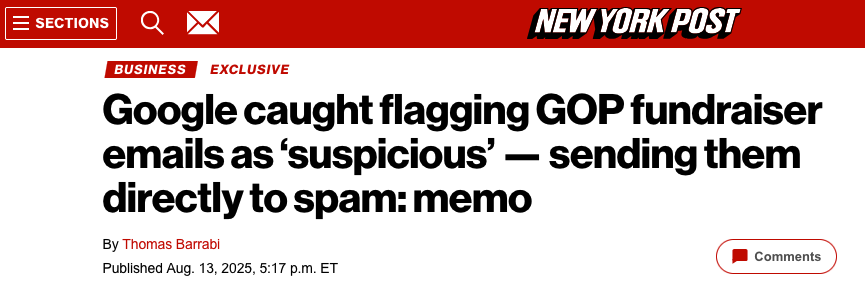
Image: nypost.com
On Aug. 13, The New York Post ran an “exclusive” story titled, “Google caught flagging GOP fundraiser emails as ‘suspicious’ — sending them directly to spam.” The story cited a memo from Targeted Victory – whose clients include the National Republican Senatorial Committee (NRSC), Rep. Steve Scalise and Sen. Marsha Blackburn – which said it observed that the “serious and troubling” trend was still going on as recently as June and July of this year.
“If Gmail is allowed to quietly suppress WinRed links while giving ActBlue a free pass, it will continue to tilt the playing field in ways that voters never see, but campaigns will feel every single day,” the memo reportedly said.
In an August 28 letter to Google CEO Sundar Pichai, FTC Chairman Andrew Ferguson cited the New York Post story and warned that Gmail’s parent Alphabet may be engaging in unfair or deceptive practices.
“Alphabet’s alleged partisan treatment of comparable messages or messengers in Gmail to achieve political objectives may violate both of these prohibitions under the FTC Act,” Ferguson wrote. “And the partisan treatment may cause harm to consumers.”
However, the situation looks very different when you ask spam experts what’s going on with WinRed’s recent messaging campaigns. Atro Tossavainen and Pekka Jalonen are co-founders at Koli-Lõks OÜ, an email intelligence company in Estonia. Koli-Lõks taps into real-time intelligence about daily spam volumes by monitoring large numbers of “spamtraps” — email addresses that are intentionally set up to catch unsolicited emails.
Spamtraps are generally not used for communication or account creation, but instead are created to identify senders exhibiting spammy behavior, such as scraping the Internet for email addresses or buying unmanaged distribution lists. As an email sender, blasting these spamtraps over and over with unsolicited email is the fastest way to ruin your domain’s reputation online. Such activity also virtually ensures that more of your messages are going to start getting listed on spam blocklists that are broadly shared within the global anti-abuse community.
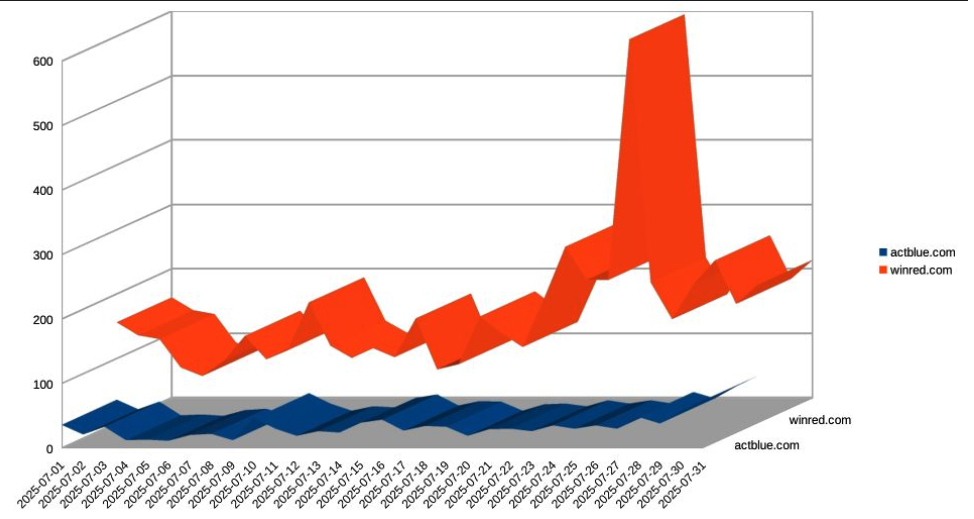
Tossavainen told KrebsOnSecurity that WinRed’s emails hit its spamtraps in the .com, .net, and .org space far more frequently than do fundraising emails sent by ActBlue. Koli-Lõks published a graph of the stark disparity in spamtrap activity for WinRed versus ActBlue, showing a nearly fourfold increase in spamtrap hits from WinRed emails in the final week of July 2025.
“Many of our spamtraps are in repurposed legacy-TLD domains (.com, .org, .net) and therefore could be understood to have been involved with a U.S. entity in their pre-zombie life,” Tossavainen explained in the LinkedIn post.
Raymond Dijkxhoorn is the CEO and a founding member of SURBL, a widely-used blocklist that flags domains and IP addresses known to be used in unsolicited messages, phishing and malware distribution. Dijkxhoorn said their spamtrap data mirrors that of Koli-Lõks, and shows that WinRed has consistently been far more aggressive in sending email than ActBlue.
Dijkxhoorn said the fact that WinRed’s emails so often end up dinging the organization’s sender reputation is not a content issue but rather a technical one.
“On our end we don’t really care if the content is political or trying to sell viagra or penis enlargements,” Dijkhoorn said. “It’s the mechanics, they should not end up in spamtraps. And that’s the reason the domain reputation is tempered. Not ‘because domain reputation firms have a political agenda.’ We really don’t care about the political situation anywhere. The same as we don’t mind people buying penis enlargements. But when either of those land in spamtraps it will impact sending experience.”
The FTC letter to Google’s CEO also referenced a debunked 2022 study (PDF) by political consultants who found Google caught more Republican emails in spam filters. Techdirt editor Mike Masnick notes that while the 2022 study also found that other email providers caught more Democratic emails as spam, “Republicans laser-focused on Gmail because it fit their victimization narrative better.”
Masnick said GOP lawmakers then filed both lawsuits and complaints with the Federal Election Commission (both of which failed easily), claiming this was somehow an “in-kind contribution” to Democrats.
“This is political posturing designed to keep the White House happy by appearing to ‘do something’ about conservative claims of ‘censorship,’” Masnick wrote of the FTC letter. “The FTC has never policed ‘political bias’ in private companies’ editorial decisions, and for good reason—the First Amendment prohibits exactly this kind of government interference.”
WinRed did not respond to a request for comment.
The WinRed website says it is an online fundraising platform supported by a united front of the Trump campaign, the Republican National Committee (RNC), the NRSC, and the National Republican Congressional Committee (NRCC).
WinRed has recently come under fire for aggressive fundraising via text message as well. In June, 404 Media reported on a lawsuit filed by a family in Utah against the RNC for allegedly bombarding their mobile phones with text messages seeking donations after they’d tried to unsubscribe from the missives dozens of times.
One of the family members said they received 27 such messages from 25 numbers, even after sending 20 stop requests. The plaintiffs in that case allege the texts from WinRed and the RNC “knowingly disregard stop requests and purposefully use different phone numbers to make it impossible to block new messages.”
Dijkhoorn said WinRed did inquire recently about why some of its assets had been marked as a risk by SURBL, but he said they appeared to have zero interest in investigating the likely causes he offered in reply.
“They only replied with, ‘You are interfering with U.S. elections,’” Dijkhoorn said, noting that many of SURBL’s spamtrap domains are only publicly listed in the registration records for random domain names.
“They’re at best harvested by themselves but more likely [they] just went and bought lists,” he said. “It’s not like ‘Oh Google is filtering this and not the other,’ the reason isn’t the provider. The reason is the fundraising spammers and the lists they send to.”
-
CISA, NSA and 19 International Partners Release Shared Vision of Software Bill of Materials for Cybersecurity Guide
CISA, NSA, and 19 international partners release a shared vision of Software Bill of Materials (SBOM) highlighting the importance of SBOM in securing global supply chains & enhancing software resilience worldwide.
-
CISA Announces Nicholas Andersen as New Executive Assistant Director for Cybersecurity
CISA Announces Nicholas Andersen as New Executive Assistant Director for Cybersecurity.
-

The Ongoing Fallout from a Breach at AI Chatbot Maker Salesloft
The recent mass-theft of authentication tokens from Salesloft, whose AI chatbot is used by a broad swath of corporate America to convert customer interaction into Salesforce leads, has left many companies racing to invalidate the stolen credentials before hackers can exploit them. Now Google warns the breach goes far beyond access to Salesforce data, noting the hackers responsible also stole valid authentication tokens for hundreds of online services that customers can integrate with Salesloft, including Slack, Google Workspace, Amazon S3, Microsoft Azure, and OpenAI.
Salesloft says its products are trusted by 5,000+ customers. Some of the bigger names are visible on the company’s homepage.
Salesloft disclosed on August 20 that, “Today, we detected a security issue in the Drift application,” referring to the technology that powers an AI chatbot used by so many corporate websites. The alert urged customers to re-authenticate the connection between the Drift and Salesforce apps to invalidate their existing authentication tokens, but it said nothing then to indicate those tokens had already been stolen.
On August 26, the Google Threat Intelligence Group (GTIG) warned that unidentified hackers tracked as UNC6395 used the access tokens stolen from Salesloft to siphon large amounts of data from numerous corporate Salesforce instances. Google said the data theft began as early as Aug. 8, 2025 and lasted through at least Aug. 18, 2025, and that the incident did not involve any vulnerability in the Salesforce platform.
Google said the attackers have been sifting through the massive data haul for credential materials such as AWS keys, VPN credentials, and credentials to the cloud storage provider Snowflake.
“If successful, the right credentials could allow them to further compromise victim and client environments, as well as pivot to the victim’s clients or partner environments,” the GTIG report stated.
The GTIG updated its advisory on August 28 to acknowledge the attackers used the stolen tokens to access email from “a very small number of Google Workstation accounts” that were specially configured to integrate with Salesloft. More importantly, it warned organizations to immediately invalidate all tokens stored in or connected to their Salesloft integrations — regardless of the third-party service in question.
“Given GTIG’s observations of data exfiltration associated with the campaign, organizations using Salesloft Drift to integrate with third-party platforms (including but not limited to Salesforce) should consider their data compromised and are urged to take immediate remediation steps,” Google advised.
On August 28, Salesforce blocked Drift from integrating with its platform, and with its productivity platforms Slack and Pardot.
The Salesloft incident comes on the heels of a broad social engineering campaign that used voice phishing to trick targets into connecting a malicious app to their organization’s Salesforce portal. That campaign led to data breaches and extortion attacks affecting a number of companies including Adidas, Allianz Life and Qantas.
On August 5, Google disclosed that one of its corporate Salesforce instances was compromised by the attackers, which the GTIG has dubbed UNC6040 (“UNC” is Google’s shorthand for “uncategorized threat group”). Google said the extortionists consistently claimed to be the threat group ShinyHunters, and that the group appeared to be preparing to escalate its extortion attacks by launching a data leak site.
ShinyHunters is an amorphous threat group known for using social engineering to break into cloud platforms and third-party IT providers, and for posting dozens of stolen databases to cybercrime communities like the now-defunct Breachforums.
The ShinyHunters brand dates back to 2020, and the group has been credited with or taken responsibility for dozens of data leaks that exposed hundreds of millions of breached records. The group’s member roster is thought to be somewhat fluid, drawing mainly from active denizens of the Com, a mostly English-language cybercrime community scattered across an ocean of Telegram and Discord servers.
Recorded Future’s Alan Liska told Bleeping Computer that the overlap in the “tools, techniques and procedures” used by ShinyHunters and the Scattered Spider extortion group likely indicate some crossover between the two groups.
To muddy the waters even further, on August 28 a Telegram channel that now has nearly 40,000 subscribers was launched under the intentionally confusing banner “Scattered LAPSUS$ Hunters 4.0,” wherein participants have repeatedly claimed responsibility for the Salesloft hack without actually sharing any details to prove their claims.
The Telegram group has been trying to attract media attention by threatening security researchers at Google and other firms. It also is using the channel’s sudden popularity to promote a new cybercrime forum called “Breachstars,” which they claim will soon host data stolen from victim companies who refuse to negotiate a ransom payment.
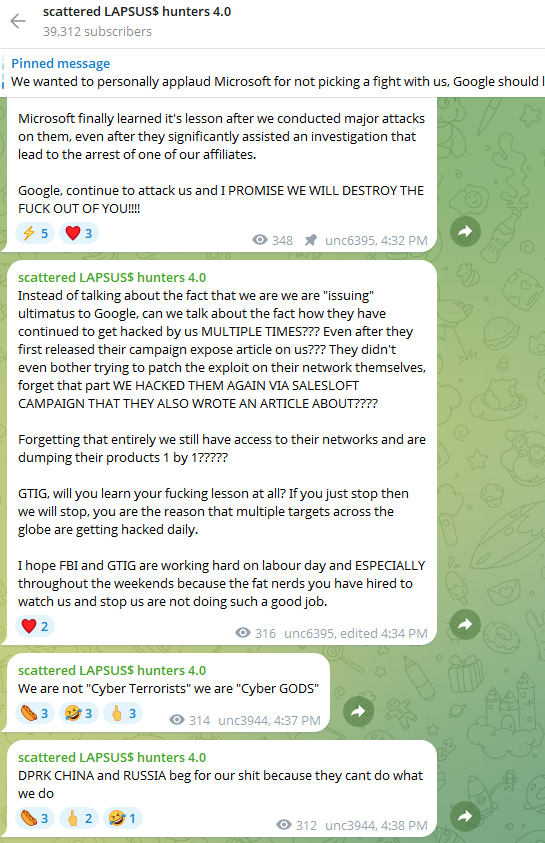
The “Scattered Lapsus$ Hunters 4.0” channel on Telegram now has roughly 40,000 subscribers.
But Austin Larsen, a principal threat analyst at Google’s threat intelligence group, said there is no compelling evidence to attribute the Salesloft activity to ShinyHunters or to other known groups at this time.
“Their understanding of the incident seems to come from public reporting alone,” Larsen told KrebsOnSecurity, referring to the most active participants in the Scattered LAPSUS$ Hunters 4.0 Telegram channel.
Joshua Wright, a senior technical director at Counter Hack, is credited with coining the term “authorization sprawl” to describe one key reason that social engineering attacks from groups like Scattered Spider and ShinyHunters so often succeed: They abuse legitimate user access tokens to move seamlessly between on-premises and cloud systems.
Wright said this type of attack chain often goes undetected because the attacker sticks to the resources and access already allocated to the user.
“Instead of the conventional chain of initial access, privilege escalation and endpoint bypass, these threat actors are using centralized identity platforms that offer single sign-on (SSO) and integrated authentication and authorization schemes,” Wright wrote in a June 2025 column. “Rather than creating custom malware, attackers use the resources already available to them as authorized users.”
It remains unclear exactly how the attackers gained access to all Salesloft Drift authentication tokens. Salesloft announced on August 27 that it hired Mandiant, Google Cloud’s incident response division, to investigate the root cause(s).
“We are working with Salesloft Drift to investigate the root cause of what occurred and then it’ll be up to them to publish that,” Mandiant Consulting CTO Charles Carmakal told Cyberscoop. “There will be a lot more tomorrow, and the next day, and the next day.”
-
Affiliates Flock to ‘Soulless’ Scam Gambling Machine
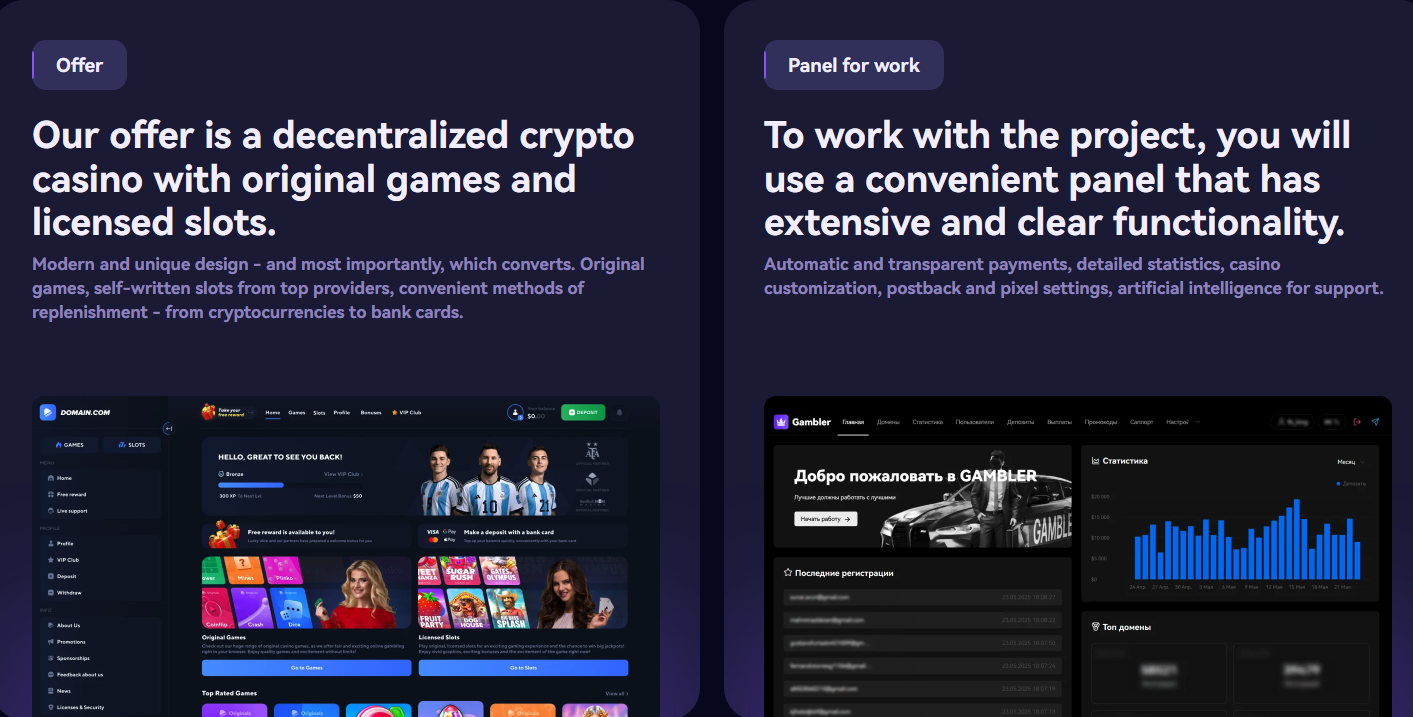
Last month, KrebsOnSecurity tracked the sudden emergence of hundreds of polished online gaming and wagering websites that lure people with free credits and eventually abscond with any cryptocurrency funds deposited by players. We’ve since learned that these scam gambling sites have proliferated thanks to a new Russian affiliate program called “Gambler Panel” that bills itself as a “soulless project that is made for profit.”
A machine-translated version of Gambler Panel’s affiliate website.
The scam begins with deceptive ads posted on social media that claim the wagering sites are working in partnership with popular athletes or social media personalities. The ads invariably state that by using a supplied “promo code,” interested players can claim a $2,500 credit on the advertised gaming website.
The gaming sites ask visitors to create a free account to claim their $2,500 credit, which they can use to play any number of extremely polished video games that ask users to bet on each action. However, when users try to cash out any “winnings” the gaming site will reject the request and prompt the user to make a “verification deposit” of cryptocurrency — typically around $100 — before any money can be distributed.
Those who deposit cryptocurrency funds are soon pressed into more wagering and making additional deposits. And — shocker alert — all players eventually lose everything they’ve invested in the platform.
The number of scam gambling or “scambling” sites has skyrocketed in the past month, and now we know why: The sites all pull their gaming content and detailed strategies for fleecing players straight from the playbook created by Gambler Panel, a Russian-language affiliate program that promises affiliates up to 70 percent of the profits.
Gambler Panel’s website gambler-panel[.]com links to a helpful wiki that explains the scam from cradle to grave, offering affiliates advice on how best to entice visitors, keep them gambling, and extract maximum profits from each victim.
“We have a completely self-written from scratch FAKE CASINO engine that has no competitors,” Gambler Panel’s wiki enthuses. “Carefully thought-out casino design in every pixel, a lot of audits, surveys of real people and test traffic floods were conducted, which allowed us to create something that has no doubts about the legitimacy and trustworthiness even for an inveterate gambling addict with many years of experience.”
Gambler Panel explains that the one and only goal of affiliates is to drive traffic to these scambling sites by any and all means possible.
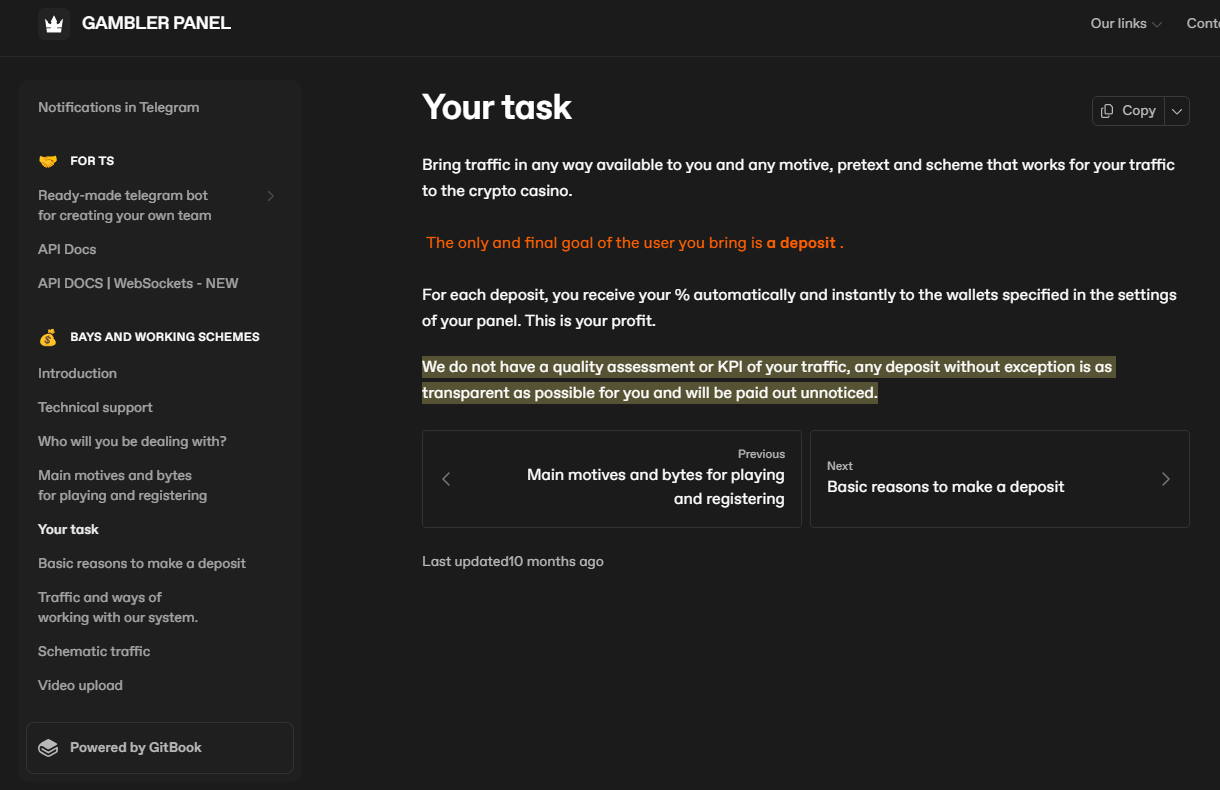
A machine-translated portion of Gambler Panel’s singular instruction for affiliates: Drive traffic to these scambling sites by any means available.
“Unlike white gambling affiliates, we accept absolutely any type of traffic, regardless of origin, the only limitation is the CIS countries,” the wiki continued, referring to a common prohibition against scamming people in Russia and former Soviet republics in the Commonwealth of Independent States.
The program’s website claims it has more than 20,000 affiliates, who earn a minimum of $10 for each verification deposit. Interested new affiliates must first get approval from the group’s Telegram channel, which currently has around 2,500 active users.
The Gambler Panel channel is replete with images of affiliate panels showing the daily revenue of top affiliates, scantily-clad young women promoting the Gambler logo, and fast cars that top affiliates claimed they bought with their earnings.
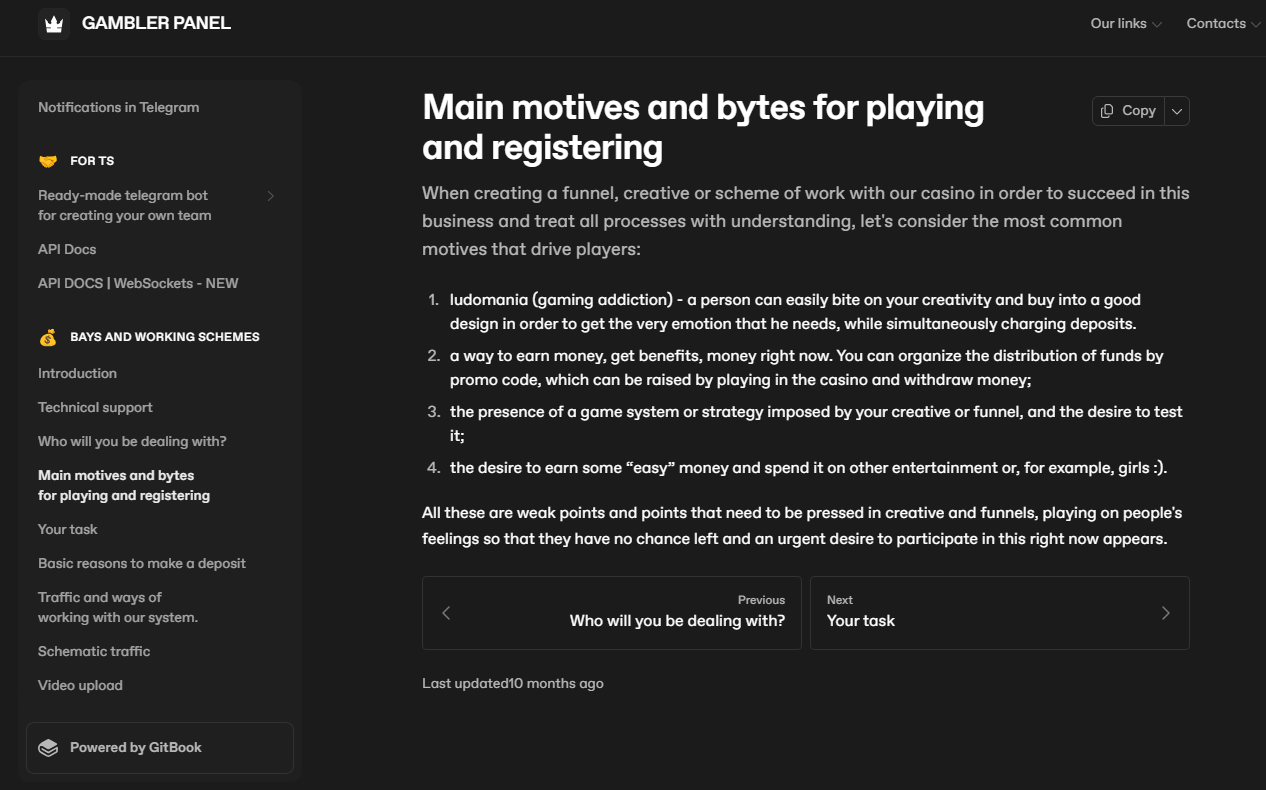
A machine-translated version of the wiki for the affiliate program Gambler Panel.
The apparent popularity of this scambling niche is a consequence of the program’s ease of use and detailed instructions for successfully reproducing virtually every facet of the scam. Indeed, much of the tutorial focuses on advice and ready-made templates to help even novice affiliates drive traffic via social media websites, particularly on Instagram and TikTok.
Gambler Panel also walks affiliates through a range of possible responses to questions from users who are trying to withdraw funds from the platform. This section, titled “Rules for working in Live chat,” urges scammers to respond quickly to user requests (1-7 minutes), and includes numerous strategies for keeping the conversation professional and the user on the platform as long as possible.
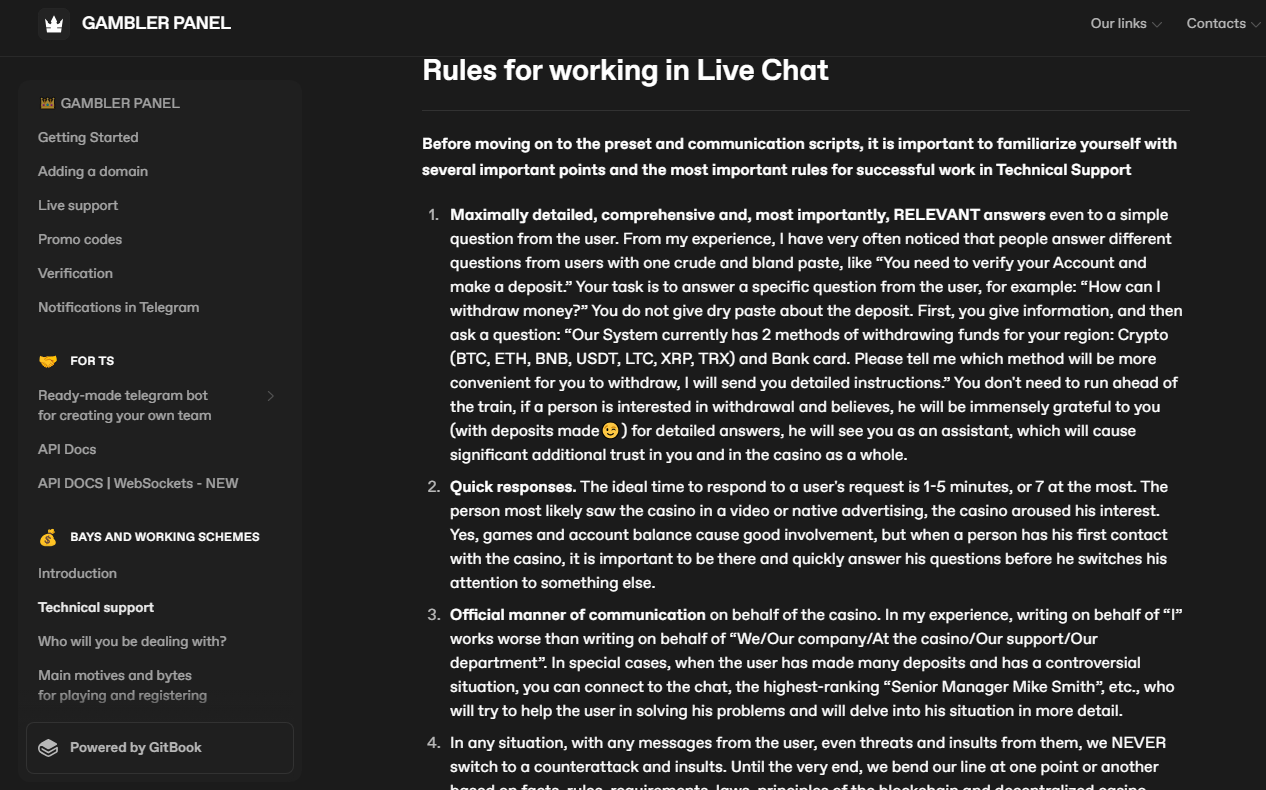
A machine-translated version of the Gambler Panel’s instructions on managing chat support conversations with users.
The connection between Gambler Panel and the explosion in the number of scambling websites was made by a 17-year-old developer who operates multiple Discord servers that have been flooded lately with misleading ads for these sites.
The researcher, who asked to be identified only by the nickname “Thereallo,” said Gambler Panel has built a scalable business product for other criminals.
“The wiki is kinda like a ‘how to scam 101’ for criminals written with the clarity you would expect from a legitimate company,” Thereallo said. “It’s clean, has step by step guides, and treats their scam platform like a real product. You could swap out the content, and it could be any documentation for startups.”
“They’ve minimized their own risk — spreading the links on Discord / Facebook / YT Shorts, etc. — and outsourced it to a hungry affiliate network, just like a franchise,” Thereallo wrote in response to questions.
“A centralized platform that can serve over 1,200 domains with a shared user base, IP tracking, and a custom API is not at all a trivial thing to build,” Thereallo said. “It’s a scalable system designed to be a resilient foundation for thousands of disposable scam sites.”
The security firm Silent Push has compiled a list of the latest domains associated with the Gambler Panel, available here (.csv).
-
CISA and Partners Providing Real-Time Incident Response to Cyber Attack on State of Nevada
CISA and its public and private sector partners are working closely with officials in Nevada as they respond to an August 24th cyber-attack targeting the state and impacting essential services.
-
CISA Adds Three Known Exploited Vulnerabilities to Catalog
CISA has added three new vulnerabilities to its Known Exploited Vulnerabilities (KEV) Catalog, based on evidence of active exploitation.
- CVE-2024-8069 Citrix Session Recording Deserialization of Untrusted Data Vulnerability
- CVE-2024-8068 Citrix Session Recording Improper Privilege Management Vulnerability
- CVE-2025-48384 Git Link Following Vulnerability
These types of vulnerabilities are frequent attack vectors for malicious cyber actors and pose significant risks to the federal enterprise.
Binding Operational Directive (BOD) 22-01: Reducing the Significant Risk of Known Exploited Vulnerabilities established the KEV Catalog as a living list of known Common Vulnerabilities and Exposures (CVEs) that carry significant risk to the federal enterprise. BOD 22-01 requires Federal Civilian Executive Branch (FCEB) agencies to remediate identified vulnerabilities by the due date to protect FCEB networks against active threats. See the BOD 22-01 Fact Sheet for more information.
Although BOD 22-01 only applies to FCEB agencies, CISA strongly urges all organizations to reduce their exposure to cyberattacks by prioritizing timely remediation of KEV Catalog vulnerabilities as part of their vulnerability management practice. CISA will continue to add vulnerabilities to the catalog that meet the specified criteria.