• CISA Adds Three Known Exploited Vulnerabilities to Catalog

    CISA has added three new vulnerabilities to its Known Exploited Vulnerabilities (KEV) Catalog, based on evidence of active exploitation.

    • CVE-2024-8069 Citrix Session Recording Deserialization of Untrusted Data Vulnerability
    • CVE-2024-8068 Citrix Session Recording Improper Privilege Management Vulnerability
    • CVE-2025-48384 Git Link Following Vulnerability

    These types of vulnerabilities are frequent attack vectors for malicious cyber actors and pose significant risks to the federal enterprise.

    Binding Operational Directive (BOD) 22-01: Reducing the Significant Risk of Known Exploited Vulnerabilities established the KEV Catalog as a living list of known Common Vulnerabilities and Exposures (CVEs) that carry significant risk to the federal enterprise. BOD 22-01 requires Federal Civilian Executive Branch (FCEB) agencies to remediate identified vulnerabilities by the due date to protect FCEB networks against active threats. See the BOD 22-01 Fact Sheet for more information.

    Although BOD 22-01 only applies to FCEB agencies, CISA strongly urges all organizations to reduce their exposure to cyberattacks by prioritizing timely remediation of KEV Catalog vulnerabilities as part of their vulnerability management practice. CISA will continue to add vulnerabilities to the catalog that meet the specified criteria.

  • CISA Requests Public Comment for Updated Guidance on Software Bill of Materials

    CISA released updated guidance for the Minimum Elements for a Software Bill of Materials (SBOM) for public comment—comment period begins today and concludes on October 3, 2025. These updates build on the 2021 version of the National Telecommunications and Information Administration SBOM Minimum Elements to reflect advancements in tooling and implementation. 

     An SBOM serves as a vital inventory of software components, enabling organizations to identify vulnerabilities, manage dependencies, and mitigate risks. The update refines data fields, automation support, and operational practices to ensure SBOMs are scalable, interoperable, and comprehensive. 

     Stakeholders are encouraged to provide feedback via the Federal Register during the public comment period. This feedback will contribute to refining SBOM practices, enabling CISA to release an updated version of the minimum elements. 
     

  • Mitsubishi Electric Corporation MELSEC iQ-F Series CPU Module

    View CSAF

    1. EXECUTIVE SUMMARY

    • CVSS v3 5.3
    • ATTENTION: Exploitable remotely/Low attack complexity
    • Vendor: Mitsubishi Electric Corporation
    • Equipment: MELSEC iQ-F Series CPU module
    • Vulnerability: Improper Handling of Length Parameter Inconsistency

    2. RISK EVALUATION

    Successful exploitation of this vulnerability could result in a remote attacker being able to delay the processing of the Web server function and prevent legitimate users from utilizing the Web server function by sending a specially crafted HTTP request.

    3. TECHNICAL DETAILS

    3.1 AFFECTED PRODUCTS

    The following versions of MELSEC iQ-F Series CPU module are affected:

    • MELSEC iQ-F Series CPU module FX5U-32MT/ES: Versions 1.060 and later
    • MELSEC iQ-F Series CPU module FX5U-32MT/DS: Versions 1.060 and later
    • MELSEC iQ-F Series CPU module FX5U-32MT/ESS: Versions 1.060 and later
    • MELSEC iQ-F Series CPU module FX5U-32MT/DSS: Versions 1.060 and later
    • MELSEC iQ-F Series CPU module FX5U-32MR/ES: Versions 1.060 and later
    • MELSEC iQ-F Series CPU module FX5U-32MR/DS: Versions 1.060 and later
    • MELSEC iQ-F Series CPU module FX5U-64MT/ES: Versions 1.060 and later
    • MELSEC iQ-F Series CPU module FX5U-64MT/DS: Versions 1.060 and later
    • MELSEC iQ-F Series CPU module FX5U-64MT/ESS: Versions 1.060 and later
    • MELSEC iQ-F Series CPU module FX5U-64MT/DSS: Versions 1.060 and later
    • MELSEC iQ-F Series CPU module FX5U-64MR/ES: Versions 1.060 and later
    • MELSEC iQ-F Series CPU module FX5U-64MR/DS: Versions 1.060 and later
    • MELSEC iQ-F Series CPU module FX5U-80MT/ES: Versions 1.060 and later
    • MELSEC iQ-F Series CPU module FX5U-80MT/DS: Versions 1.060 and later
    • MELSEC iQ-F Series CPU module FX5U-80MT/ESS: Versions 1.060 and later
    • MELSEC iQ-F Series CPU module FX5U-80MT/DSS: Versions 1.060 and later
    • MELSEC iQ-F Series CPU module FX5U-80MR/ES: Versions 1.060 and later
    • MELSEC iQ-F Series CPU module FX5U-80MR/DS: Versions 1.060 and later
    • MELSEC iQ-F Series CPU module FX5UC-32MT/D: Versions 1.060 and later
    • MELSEC iQ-F Series CPU module FX5UC-32MT/DSS: Versions 1.060 and later
    • MELSEC iQ-F Series CPU module FX5UC-64MT/D: Versions 1.060 and later
    • MELSEC iQ-F Series CPU module FX5UC-64MT/DSS: Versions 1.060 and later
    • MELSEC iQ-F Series CPU module FX5UC-96MT/D: Versions 1.060 and later
    • MELSEC iQ-F Series CPU module FX5UC-96MT/DSS: Versions 1.060 and later
    • MELSEC iQ-F Series CPU module FX5UC-32MT/DS-TS: Versions 1.060 and later
    • MELSEC iQ-F Series CPU module FX5UC-32MT/DSS-TS: Versions 1.060 and later
    • MELSEC iQ-F Series CPU module FX5UC-32MR/DS-TS: Versions 1.060 and later
    • MELSEC iQ-F Series CPU module FX5UJ-24MT/ES: All versions
    • MELSEC iQ-F Series CPU module FX5UJ-24MT/DS: All versions
    • MELSEC iQ-F Series CPU module FX5UJ-24MT/ESS: All versions
    • MELSEC iQ-F Series CPU module FX5UJ-24MT/DSS: All versions
    • MELSEC iQ-F Series CPU module FX5UJ-24MR/ES: All versions
    • MELSEC iQ-F Series CPU module FX5UJ-24MR/DS: All versions
    • MELSEC iQ-F Series CPU module FX5UJ-40MT/ES: All versions
    • MELSEC iQ-F Series CPU module FX5UJ-40MT/DS: All versions
    • MELSEC iQ-F Series CPU module FX5UJ-40MT/ESS: All versions
    • MELSEC iQ-F Series CPU module FX5UJ-40MT/DSS: All versions
    • MELSEC iQ-F Series CPU module FX5UJ-40MR/ES: All versions
    • MELSEC iQ-F Series CPU module FX5UJ-40MR/DS: All versions
    • MELSEC iQ-F Series CPU module FX5UJ-60MT/ES: All versions
    • MELSEC iQ-F Series CPU module FX5UJ-60MT/DS: All versions
    • MELSEC iQ-F Series CPU module FX5UJ-60MT/ESS: All versions
    • MELSEC iQ-F Series CPU module FX5UJ-60MT/DSS: All versions
    • MELSEC iQ-F Series CPU module FX5UJ-60MR/ES: All versions
    • MELSEC iQ-F Series CPU module FX5UJ-60MR/DS: All versions
    • MELSEC iQ-F Series CPU module FX5UJ-24MT/ES-A: All versions
    • MELSEC iQ-F Series CPU module FX5UJ-24MR/ES-A: All versions
    • MELSEC iQ-F Series CPU module FX5UJ-40MT/ES-A: All versions
    • MELSEC iQ-F Series CPU module FX5UJ-40MR/ES-A: All versions
    • MELSEC iQ-F Series CPU module FX5UJ-60MT/ES-A: All versions
    • MELSEC iQ-F Series CPU module FX5UJ-60MR/ES-A: All versions
    • MELSEC iQ-F Series CPU module FX5S-30MT/ES: All versions
    • MELSEC iQ-F Series CPU module FX5S-30MT/DS: All versions
    • MELSEC iQ-F Series CPU module FX5S-30MT/ESS: All versions
    • MELSEC iQ-F Series CPU module FX5S-30MT/DSS: All versions
    • MELSEC iQ-F Series CPU module FX5S-30MR/ES: All versions
    • MELSEC iQ-F Series CPU module FX5S-30MR/DS: All versions
    • MELSEC iQ-F Series CPU module FX5S-40MT/ES: All versions
    • MELSEC iQ-F Series CPU module FX5S-40MT/DS: All versions
    • MELSEC iQ-F Series CPU module FX5S-40MT/ESS: All versions
    • MELSEC iQ-F Series CPU module FX5S-40MT/DSS: All versions
    • MELSEC iQ-F Series CPU module FX5S-40MR/ES: All versions
    • MELSEC iQ-F Series CPU module FX5S-40MR/DS: All versions
    • MELSEC iQ-F Series CPU module FX5S-60MT/ES: All versions
    • MELSEC iQ-F Series CPU module FX5S-60MT/DS: All versions
    • MELSEC iQ-F Series CPU module FX5S-60MT/ESS: All versions
    • MELSEC iQ-F Series CPU module FX5S-60MT/DSS: All versions
    • MELSEC iQ-F Series CPU module FX5S-60MR/ES: All versions
    • MELSEC iQ-F Series CPU module FX5S-60MR/DS: All versions
    • MELSEC iQ-F Series CPU module FX5S-80MT/ES: All versions
    • MELSEC iQ-F Series CPU module FX5S-80MT/ESS: All versions
    • MELSEC iQ-F Series CPU module FX5S-80MR/ES: All versions

    3.2 VULNERABILITY OVERVIEW

    3.2.1 IMPROPER HANDLING OF LENGTH PARAMETER INCONSISTENCY CWE-130

    A Denial-of-Service (DoS) vulnerability due to Improper Handling of Length Parameter Inconsistency exists in the Web server function of the MELSEC iQ-F Series CPU module.

    CVE-2025-5514 has been assigned to this vulnerability. A CVSS v3 base score of 5.3 has been calculated; the CVSS vector string is (AV:N/AC:L/PR:N/UI:N/S:U/C:N/I:N/A:L).

    3.3 BACKGROUND

    • CRITICAL INFRASTRUCTURE SECTORS: Critical Manufacturing
    • COUNTRIES/AREAS DEPLOYED: Worldwide
    • COMPANY HEADQUARTERS LOCATION: Japan

    3.4 RESEARCHER

    Thai Do, Minh Pham, Quan Le, and Loc Nguyen of OPSWAT Unit515 reported this vulnerability to Mitsubishi Electric Corporation. Mitsubishi Electric Corporation reported this vulnerability to CISA.

    4. MITIGATIONS

    Mitsubishi Electric Corporation advises that there are no plans to release a fixed version. Mitsubishi Electric recommends users take the following mitigation measures to minimize the risk of exploiting this vulnerability:

    • Use a firewall or virtual private network (VPN), etc. to prevent unauthorized access when Internet access is required.
    • Use within a LAN and block access from untrusted networks and hosts through firewalls.
    • Use IP filter function to block access from untrusted hosts. For details on the IP filter function, please refer to the manual for each product: “13.1 IP Filter Function” in the MELSEC iQ-F FX5 User’s Manual (Communication).
    • Restrict physical access to the affected products and the LAN connected by them.

    Mitsubishi Electric Corporation recommends users contact their local Mitsubishi Electric representative with questions.

    For more information, see Mitsubishi Electric’s security advisory.

    CISA recommends users take defensive measures to minimize the risk of exploitation of this vulnerability, such as:

    • Minimize network exposure for all control system devices and/or systems, ensuring they are not accessible from the internet.
    • Locate control system networks and remote devices behind firewalls and isolating them from business networks.
    • When remote access is required, use more secure methods, such as Virtual Private Networks (VPNs), recognizing VPNs may have vulnerabilities and should be updated to the most current version available. Also recognize VPN is only as secure as the connected devices.

    CISA reminds organizations to perform proper impact analysis and risk assessment prior to deploying defensive measures.

    CISA also provides a section for control systems security recommended practices on the ICS webpage on cisa.gov/ics. Several CISA products detailing cyber defense best practices are available for reading and download, including Improving Industrial Control Systems Cybersecurity with Defense-in-Depth Strategies.

    CISA encourages organizations to implement recommended cybersecurity strategies for proactive defense of ICS assets.

    Additional mitigation guidance and recommended practices are publicly available on the ICS webpage at cisa.gov/ics in the technical information paper, ICS-TIP-12-146-01B–Targeted Cyber Intrusion Detection and Mitigation Strategies.

    Organizations observing suspected malicious activity should follow established internal procedures and report findings to CISA for tracking and correlation against other incidents.

    No known public exploitation specifically targeting this vulnerability has been reported to CISA at this time.

    5. UPDATE HISTORY

    • August 21, 2025: Initial Publication
  • FUJIFILM Healthcare Americas Synapse Mobility

    View CSAF

    1. EXECUTIVE SUMMARY

    • CVSS v4 5.3
    • ATTENTION: Exploitable remotely/low attack complexity
    • Vendor: FUJIFILM Healthcare Americas Corporation
    • Equipment: Synapse Mobility
    • Vulnerability: External Control of Assumed-Immutable Web Parameter

    2. RISK EVALUATION

    Successful exploitation of this vulnerability could allow an attacker to access information beyond their assigned roles.

    3. TECHNICAL DETAILS

    3.1 AFFECTED PRODUCTS

    The following versions of FUJIFILM Healthcare Americas Synapse Mobility are affected:

    • Synapse Mobility: Versions prior to 8.2

    3.2 VULNERABILITY OVERVIEW

    3.2.1 EXTERNAL CONTROL OF ASSUMED-IMMUTABLE WEB PARAMETER CWE-472

    FUJIFILM Healthcare Americas Synapse Mobility versions prior to 8.2 contains a privilege escalation vulnerability through external control of Web parameter. Exploitation of this vulnerability could allow an attacker to bypass authentication and access information beyond role-based access controls.

    CVE-2025-54551 has been assigned to this vulnerability. A CVSS v3.1 base score of 4.3 has been calculated; the CVSS vector string is (AV:N/AC:L/PR:L/UI:N/S:U/C:L/I:N/A:N).

    A CVSS v4 score has also been calculated for CVE-2025-54551. A base score of 5.3 has been calculated; the CVSS vector string is (AV:N/AC:L/AT:N/PR:L/UI:N/VC:L/VI:N/VA:N/SC:N/SI:N/SA:N).

    3.3 BACKGROUND

    • CRITICAL INFRASTRUCTURE SECTORS: Healthcare and Public Health
    • COUNTRIES/AREAS DEPLOYED: Worldwide
    • COMPANY HEADQUARTERS LOCATION: Japan

    3.4 RESEARCHER

    Christopher Alejandro (Moroco) reported this vulnerability to CISA.

    4. MITIGATIONS

    FUJIFILM Healthcare Americas has released the following mitigation options for users to follow:

    • It is recommended to upgrade to the latest version of the product or any version from 8.2 and later to resolve this issue.
    • There is an immediate mitigation available of disabling the search function in the configurator settings. Access to the search function for all users can also be removed by unchecking the “Allow plain text accession number” check box in the security section of the admin interface. This will limit the site to use of the product only via the SecureURL feature.
    • Patches have been released which will remediate the vulnerability for software versions 8.0-8.1.1.

    FUJIFILM Healthcare Americas strongly encourages users to update the Synapse Mobility application to the latest version if they are past their end of support date.

    For more information, refer to Synapse Mobility Vulnerability Notification.

    CISA recommends users take defensive measures to minimize the risk of exploitation of this vulnerability, such as:

    • Minimize network exposure for all control system devices and/or systems, ensuring they are not accessible from the internet.
    • Locate control system networks and remote devices behind firewalls and isolating them from business networks.
    • When remote access is required, use more secure methods, such as Virtual Private Networks (VPNs), recognizing VPNs may have vulnerabilities and should be updated to the most current version available. Also recognize VPN is only as secure as the connected devices.

    CISA reminds organizations to perform proper impact analysis and risk assessment prior to deploying defensive measures.

    CISA also provides a section for control systems security recommended practices on the ICS webpage on cisa.gov/ics. Several CISA products detailing cyber defense best practices are available for reading and download, including Improving Industrial Control Systems Cybersecurity with Defense-in-Depth Strategies.

    CISA encourages organizations to implement recommended cybersecurity strategies for proactive defense of ICS assets.

    Additional mitigation guidance and recommended practices are publicly available on the ICS webpage at cisa.gov/ics in the technical information paper, ICS-TIP-12-146-01B–Targeted Cyber Intrusion Detection and Mitigation Strategies.

    Organizations observing suspected malicious activity should follow established internal procedures and report findings to CISA for tracking and correlation against other incidents.

    CISA also recommends users take the following measures to protect themselves from social engineering attacks:

    No known public exploitation specifically targeting this vulnerability has been reported to CISA at this time.

    5. UPDATE HISTORY

    • August 21, 2025: Initial Publication
  • CISA Adds One Known Exploited Vulnerability to Catalog

    CISA has added one new vulnerability to its Known Exploited Vulnerabilities (KEV) Catalog, based on evidence of active exploitation. 

    • CVE-2025-43300 Apple iOS, iPadOS, and macOS Out-of-Bounds Write Vulnerability

    This type of vulnerability is a frequent attack vector for malicious cyber actors and poses significant risks to the federal enterprise.

    Binding Operational Directive (BOD) 22-01: Reducing the Significant Risk of Known Exploited Vulnerabilities established the KEV Catalog as a living list of known Common Vulnerabilities and Exposures (CVEs) that carry significant risk to the federal enterprise. BOD 22-01 requires Federal Civilian Executive Branch (FCEB) agencies to remediate identified vulnerabilities by the due date to protect FCEB networks against active threats. See the BOD 22-01 Fact Sheet for more information. 

    Although BOD 22-01 only applies to FCEB agencies, CISA strongly urges all organizations to reduce their exposure to cyberattacks by prioritizing timely remediation of KEV Catalog vulnerabilities as part of their vulnerability management practice. CISA will continue to add vulnerabilities to the catalog that meet the specified criteria

  • CISA Releases Three Industrial Control Systems Advisories

    CISA released three Industrial Control Systems (ICS) advisories on August 21, 2025. These advisories provide timely information about current security issues, vulnerabilities, and exploits surrounding ICS.

    CISA encourages users and administrators to review newly released ICS advisories for technical details and mitigations.

  • SIM-Swapper, Scattered Spider Hacker Gets 10 Years

    SIM-Swapper, Scattered Spider Hacker Gets 10 Years


    A 20-year-old Florida man at the center of a prolific cybercrime group known as “Scattered Spider” was sentenced to 10 years in federal prison today, and ordered to pay roughly $13 million in restitution to victims.

    Noah Michael Urban of Palm Coast, Fla. pleaded guilty in April 2025 to charges of wire fraud and conspiracy. Florida prosecutors alleged Urban conspired with others to steal at least $800,000 from five victims via SIM-swapping attacks that diverted their mobile phone calls and text messages to devices controlled by Urban and his co-conspirators.

    A booking photo of Noah Michael Urban released by the Volusia County Sheriff.

    Although prosecutors had asked for Urban to serve eight years, Jacksonville news outlet News4Jax.com reports the federal judge in the case today opted to sentence Urban to 120 months in federal prison, ordering him to pay $13 million in restitution and undergo three years of supervised release after his sentence is completed.

    In November 2024 Urban was charged by federal prosecutors in Los Angeles as one of five members of Scattered Spider (a.k.a. “Oktapus,” “Scatter Swine” and “UNC3944”), which specialized in SMS and voice phishing attacks that tricked employees at victim companies into entering their credentials and one-time passcodes at phishing websites. Urban pleaded guilty to one count of conspiracy to commit wire fraud in the California case, and the $13 million in restitution is intended to cover victims from both cases.

    The targeted SMS scams spanned several months during the summer of 2022, asking employees to click a link and log in at a website that mimicked their employer’s Okta authentication page. Some SMS phishing messages told employees their VPN credentials were expiring and needed to be changed; other missives advised employees about changes to their upcoming work schedule.

    That phishing spree netted Urban and others access to more than 130 companies, including Twilio, LastPass, DoorDash, MailChimp, and Plex. The government says the group used that access to steal proprietary company data and customer information, and that members also phished people to steal millions of dollars worth of cryptocurrency.

    For many years, Urban’s online hacker aliases “King Bob” and “Sosa” were fixtures of the Com, a mostly Telegram and Discord-based community of English-speaking cybercriminals wherein hackers boast loudly about high-profile exploits and hacks that almost invariably begin with social engineering. King Bob constantly bragged on the Com about stealing unreleased rap music recordings from popular artists, presumably through SIM-swapping attacks. Many of those purloined tracks or “grails” he later sold or gave away on forums.

    Noah “King Bob” Urban, posting to Twitter/X around the time of his sentencing today.

    Sosa also was active in a particularly destructive group of accomplished criminal SIM-swappers known as “Star Fraud.” Cyberscoop’s AJ Vicens reported in 2023 that individuals within Star Fraud were likely involved in the high-profile Caesars Entertainment and MGM Resorts extortion attacks that same year.

    The Star Fraud SIM-swapping group gained the ability to temporarily move targeted mobile numbers to devices they controlled by constantly phishing employees of the major mobile providers. In February 2023, KrebsOnSecurity published data taken from the Telegram channels for Star Fraud and two other SIM-swapping groups showing these crooks focused on SIM-swapping T-Mobile customers, and that they collectively claimed internal access to T-Mobile on 100 separate occasions over a 7-month period in 2022.

    Reached via one of his King Bob accounts on Twitter/X, Urban called the sentence unjust, and said the judge in his case discounted his age as a factor.

    “The judge purposefully ignored my age as a factor because of the fact another Scattered Spider member hacked him personally during the course of my case,” Urban said in reply to questions, noting that he was sending the messages from a Florida county jail. “He should have been removed as a judge much earlier on. But staying in county jail is torture.”

    A court transcript (PDF) from a status hearing in February 2025 shows Urban was telling the truth about the hacking incident that happened while he was in federal custody. It involved an intrusion into a magistrate judge’s email account, where a copy of Urban’s sealed indictment was stolen. The judge told attorneys for both sides that a co-defendant in the California case was trying to find out about Mr. Urban’s activity in the Florida case.

    “What it ultimately turned into a was a big faux pas,” Judge Harvey E. Schlesinger said. “The Court’s password…business is handled by an outside contractor. And somebody called the outside contractor representing Judge Toomey saying, ‘I need a password change.’ And they gave out the password change. That’s how whoever was making the phone call got into the court.”

  • Oregon Man Charged in ‘Rapper Bot’ DDoS Service

    Oregon Man Charged in ‘Rapper Bot’ DDoS Service


    A 22-year-old Oregon man has been arrested on suspicion of operating “Rapper Bot,” a massive botnet used to power a service for launching distributed denial-of-service (DDoS) attacks against targets — including a March 2025 DDoS that knocked Twitter/X offline. The Justice Department asserts the suspect and an unidentified co-conspirator rented out the botnet to online extortionists, and tried to stay off the radar of law enforcement by ensuring that their botnet was never pointed at KrebsOnSecurity.

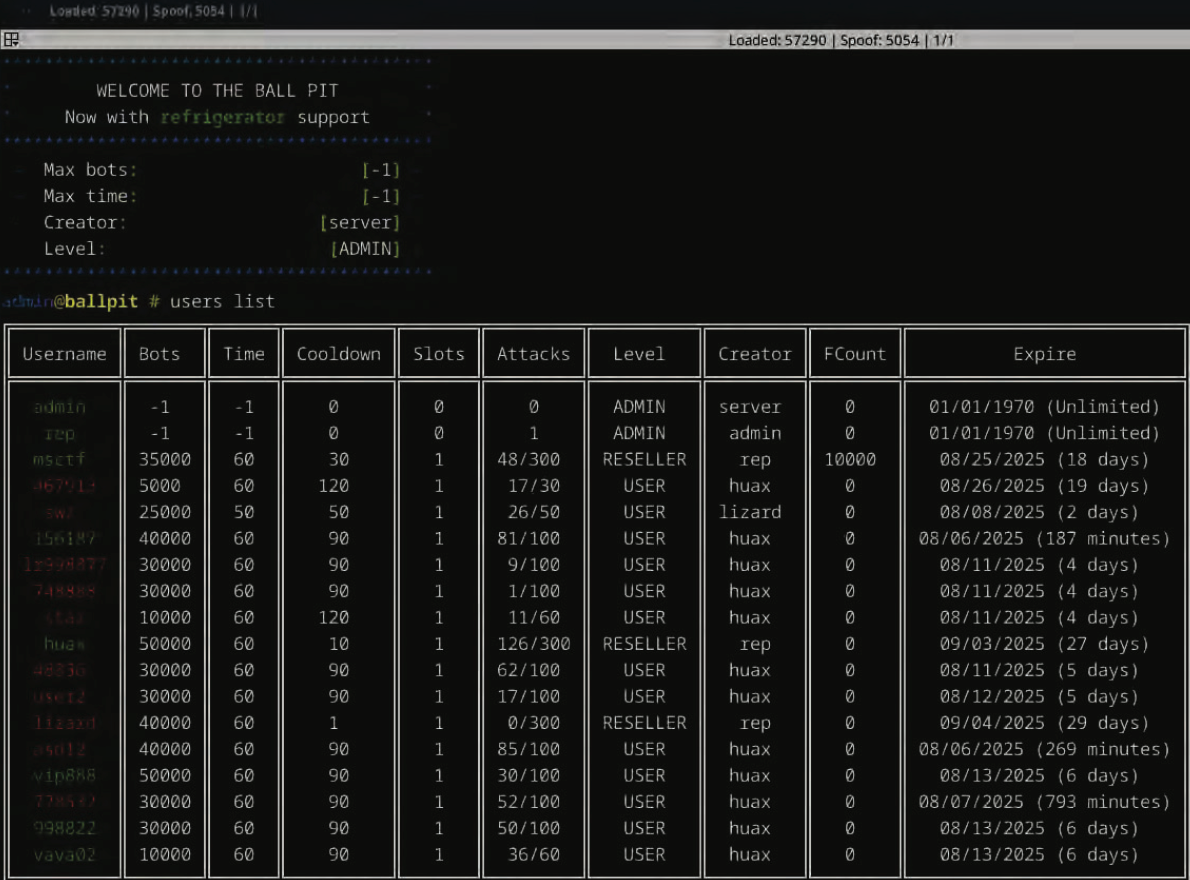
    The control panel for the Rapper Bot botnet greets users with the message “Welcome to the Ball Pit, Now with refrigerator support,” an apparent reference to a handful of IoT-enabled refrigerators that were enslaved in their DDoS botnet.

    On August 6, 2025, federal agents arrested Ethan J. Foltz of Springfield, Ore. on suspicion of operating Rapper Bot, a globally dispersed collection of tens of thousands of hacked Internet of Things (IoT) devices.

    The complaint against Foltz explains the attacks usually clocked in at more than two terabits of junk data per second (a terabit is one trillion bits of data), which is more than enough traffic to cause serious problems for all but the most well-defended targets. The government says Rapper Bot consistently launched attacks that were “hundreds of times larger than the expected capacity of a typical server located in a data center,” and that some of its biggest attacks exceeded six terabits per second.

    Indeed, Rapper Bot was reportedly responsible for the March 10, 2025 attack that caused intermittent outages on Twitter/X. The government says Rapper Bot’s most lucrative and frequent customers were involved in extorting online businesses — including numerous gambling operations based in China.

    The criminal complaint was written by Elliott Peterson, an investigator with the Defense Criminal Investigative Service (DCIS), the criminal investigative division of the Department of Defense (DoD) Office of Inspector General. The complaint notes the DCIS got involved because several Internet addresses maintained by the DoD were the target of Rapper Bot attacks.

    Peterson said he tracked Rapper Bot to Foltz after a subpoena to an ISP in Arizona that was hosting one of the botnet’s control servers showed the account was paid for via PayPal. More legal process to PayPal revealed Foltz’s Gmail account and previously used IP addresses. A subpoena to Google showed the defendant searched security blogs constantly for news about Rapper Bot, and for updates about competing DDoS-for-hire botnets.

    According to the complaint, after having a search warrant served on his residence the defendant admitted to building and operating Rapper Bot, sharing the profits 50/50 with a person he claimed to know only by the hacker handle “Slaykings.” Foltz also shared with investigators the logs from his Telegram chats, wherein Foltz and Slaykings discussed how best to stay off the radar of law enforcement investigators while their competitors were getting busted.

    Specifically, the two hackers chatted about a May 20 attack against KrebsOnSecurity.com that clocked in at more than 6.3 terabits of data per second. The brief attack was notable because at the time it was the largest DDoS that Google had ever mitigated (KrebsOnSecurity sits behind the protection of Project Shield, a free DDoS defense service that Google provides to websites offering news, human rights, and election-related content).

    The May 2025 DDoS was launched by an IoT botnet called Aisuru, which I discovered was operated by a 21-year-old man in Brazil named Kaike Southier Leite. This individual was more commonly known online as “Forky,” and Forky told me he wasn’t afraid of me or U.S. federal investigators. Nevertheless, the complaint against Foltz notes that Forky’s botnet seemed to diminish in size and firepower at the same time that Rapper Bot’s infection numbers were on the upswing.

    “Both FOLTZ and Slaykings were very dismissive of attention seeking activities, the most extreme of which, in their view, was to launch DDoS attacks against the website of the prominent cyber security journalist Brian Krebs,” Peterson wrote in the criminal complaint.

    “You see, they’ll get themselves [expletive],” Slaykings wrote in response to Foltz’s comments about Forky and Aisuru bringing too much heat on themselves.

    “Prob cuz [redacted] hit krebs,” Foltz wrote in reply.

    “Going against Krebs isn’t a good move,” Slaykings concurred. “It isn’t about being a [expletive] or afraid, you just get a lot of problems for zero money. Childish, but good. Let them die.”

    “Ye, it’s good tho, they will die,” Foltz replied.

    The government states that just prior to Foltz’s arrest, Rapper Bot had enslaved an estimated 65,000 devices globally. That may sound like a lot, but the complaint notes the defendants weren’t interested in making headlines for building the world’s largest or most powerful botnet.

    Quite the contrary: The complaint asserts that the accused took care to maintain their botnet in a “Goldilocks” size — ensuring that “the number of devices afforded powerful attacks while still being manageable to control and, in the hopes of Foltz and his partners, small enough to not be detected.”

    The complaint states that several days later, Foltz and Slaykings returned to discussing what that they expected to befall their rival group, with Slaykings stating, “Krebs is very revenge. He won’t stop until they are [expletive] to the bone.”

    “Surprised they have any bots left,” Foltz answered.

    “Krebs is not the one you want to have on your back. Not because he is scary or something, just because he will not give up UNTIL you are [expletive] [expletive]. Proved it with Mirai and many other cases.”

    [Unknown expletives aside, that may well be the highest compliment I’ve ever been paid by a cybercriminal. I might even have part of that quote made into a t-shirt or mug or something. It’s also nice that they didn’t let any of their customers attack my site — if even only out of a paranoid sense of self-preservation.]

    Foltz admitted to wiping the user and attack logs for the botnet approximately once a week, so investigators were unable to tally the total number of attacks, customers and targets of this vast crime machine. But the data that was still available showed that from April 2025 to early August, Rapper Bot conducted over 370,000 attacks, targeting 18,000 unique victims across 1,000 networks, with the bulk of victims residing in China, Japan, the United States, Ireland and Hong Kong (in that order).

    According to the government, Rapper Bot borrows much of its code from fBot, a DDoS malware strain also known as Satori. In 2020, authorities in Northern Ireland charged a then 20-year-old man named Aaron “Vamp” Sterritt with operating fBot with a co-conspirator. U.S. prosecutors are still seeking Sterritt’s extradition to the United States. fBot is itself a variation of the Mirai IoT botnet that has ravaged the Internet with DDoS attacks since its source code was leaked back in 2016.

    The complaint says Foltz and his partner did not allow most customers to launch attacks that were more than 60 seconds in duration — another way they tried to keep public attention to the botnet at a minimum. However, the government says the proprietors also had special arrangements with certain high-paying clients that allowed much larger and longer attacks.
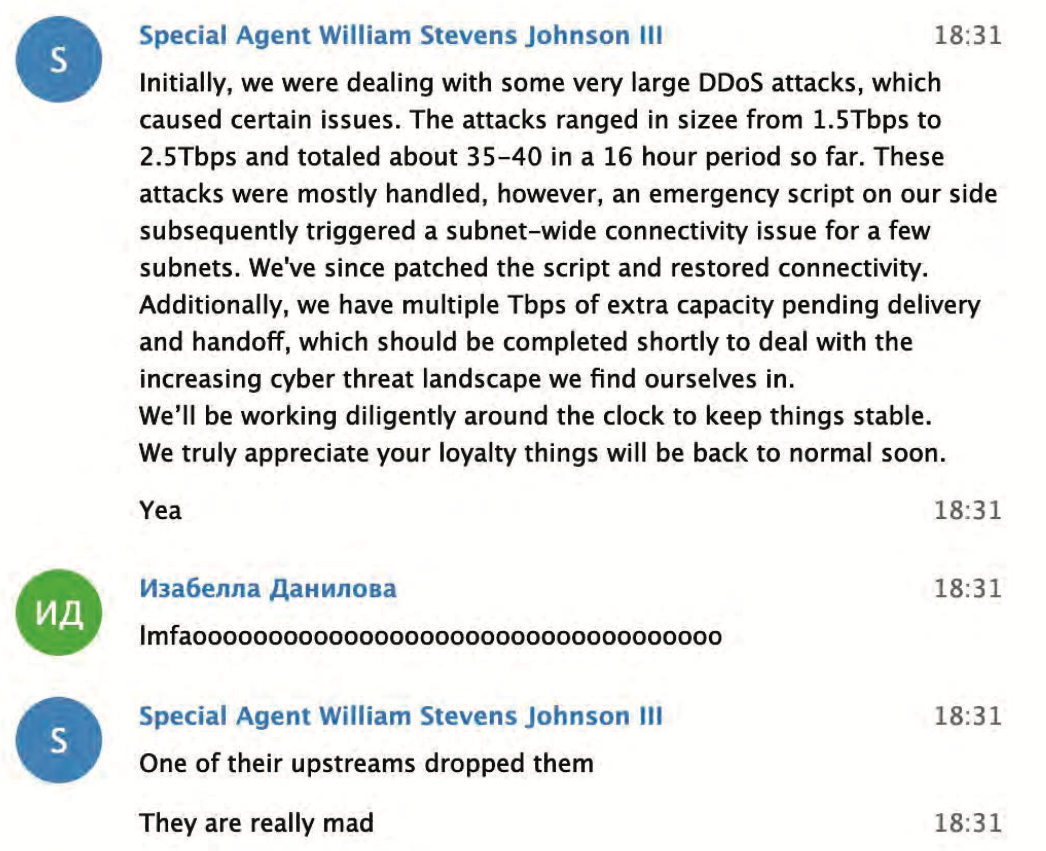
    The accused and his alleged partner made light of this blog post about the fallout from one of their botnet attacks.

    Most people who have never been on the receiving end of a monster DDoS attack have no idea of the cost and disruption that such sieges can bring. The DCIS’s Peterson wrote that he was able to test the botnet’s capabilities while interviewing Foltz, and that found that “if this had been a server upon which I was running a website, using services such as load balancers, and paying for both outgoing and incoming data, at estimated industry average rates the attack (2+ Terabits per second times 30 seconds) might have cost the victim anywhere from $500 to $10,000.”

    “DDoS attacks at this scale often expose victims to devastating financial impact, and a potential alternative, network engineering solutions that mitigate the expected attacks such as overprovisioning, i.e. increasing potential Internet capacity, or DDoS defense technologies, can themselves be prohibitively expensive,” the complaint continues. “This ‘rock and a hard place’ reality for many victims can leave them acutely exposed to extortion demands – ‘pay X dollars and the DDoS attacks stop’.”

    The Telegram chat records show that the day before Peterson and other federal agents raided Foltz’s residence, Foltz allegedly told his partner he’d found 32,000 new devices that were vulnerable to a previously unknown exploit.
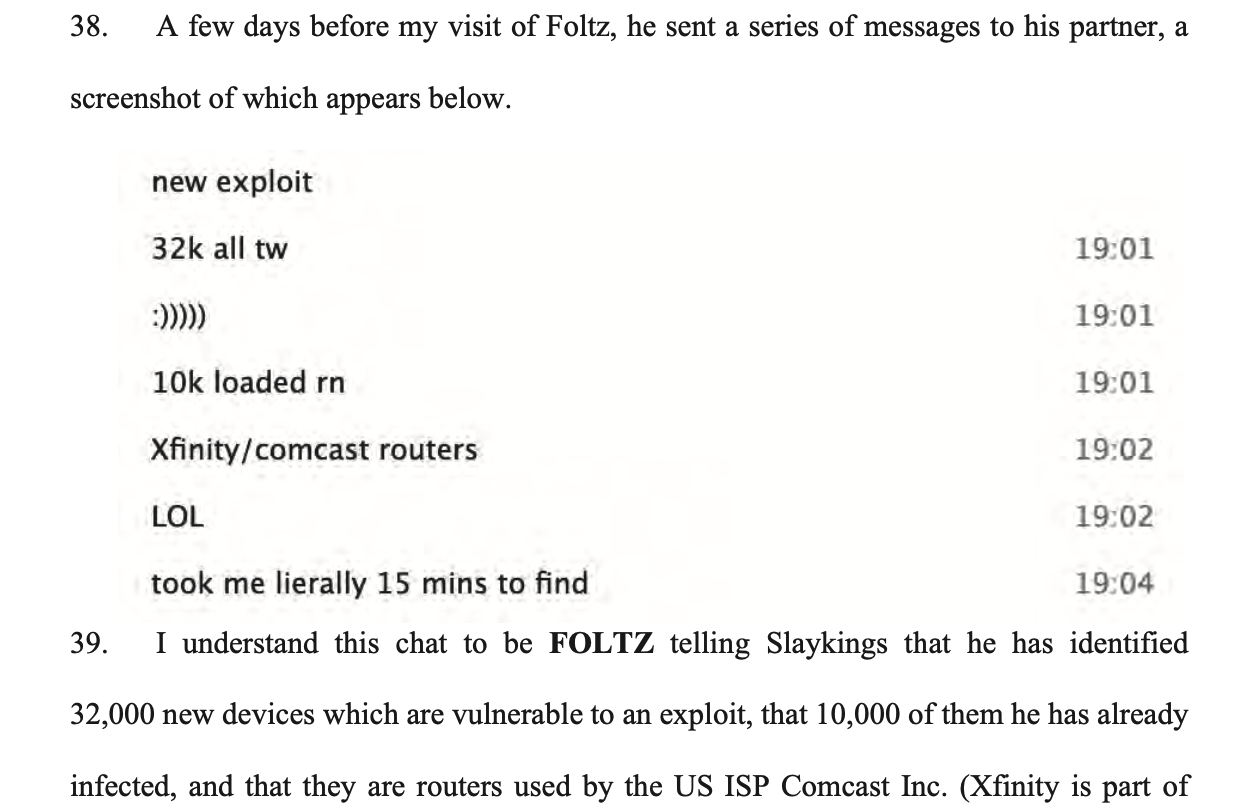
    Foltz and Slaykings discussing the discovery of an IoT vulnerability that will give them 32,000 new devices.

    Shortly before the search warrant was served on his residence, Foltz allegedly told his partner that “Once again we have the biggest botnet in the community.” The following day, Foltz told his partner that it was going to be a great day — the biggest so far in terms of income generated by Rapper Bot.

    “I sat next to Foltz while the messages poured in — promises of $800, then $1,000, the proceeds ticking up as the day went on,” Peterson wrote. “Noticing a change in Foltz’ behavior and concerned that Foltz was making changes to the botnet configuration in real time, Slaykings asked him ‘What’s up?’ Foltz deftly typed out some quick responses. Reassured by Foltz’ answer, Slaykings responded, ‘Ok, I’m the paranoid one.”

    The case is being prosecuted by Assistant U.S. Attorney Adam Alexander in the District of Alaska (at least some of the devices found to be infected with Rapper Bot were located there, and it is where Peterson is stationed). Foltz faces one count of aiding and abetting computer intrusions. If convicted, he faces a maximum penalty of 10 years in prison, although a federal judge is unlikely to award anywhere near that kind of sentence for a first-time conviction.